Prince Tennis Rackets: From the Oversize Revolution to Modern Classics
If you walked onto a tennis court in the 1990s, you couldn't swing a cat without hitting a Prince racket. Founded in 1970, the brand literally changed the geometry of the sport. They were the ones who realized that making the head size larger made the game easier and more fun for everyone.
It started with Howard Head (the same guy who revolutionized ski equipment) patenting the first oversized racket. Since then, Prince has been wielded by legends like Andre Agassi, Michael Chang, and Maria Sharapova. While their market share dipped slightly as other giants rose, they have recently surged back into the limelight.
Prince isn't just relying on nostalgia. They have reorganized, refocused, and are currently producing some of the most comfortable, arm-friendly frames on the market. They sit in a unique position as a heritage brand. They aren't afraid to make their rackets look like Swiss cheese for better physics.
What is the Engineering Philosophy Behind Prince Racket Design?
Prince has always been the "mad scientist" of the tennis world. While others iterate on paint jobs and minor tweaks, Prince tends to rethink the frame entirely. Their philosophy centers on two main pillars: maximize the sweet spot and minimize shock.
They approach racket design with a heavy focus on aerodynamics and string movement. You will notice this immediately with their visible tech. They don't hide innovations inside the handle. Instead, they drill giant holes in the frame or weave visible carbon fiber patterns.
The goal is to create equipment that offers a "plush" response. Modern eras are dominated by stiff, hollow, power-oriented frames that can hurt tendons. Prince has doubled down on flexibility. They build rackets for players who want to feel the ball dwell on the string bed. It shouldn't just bounce off.
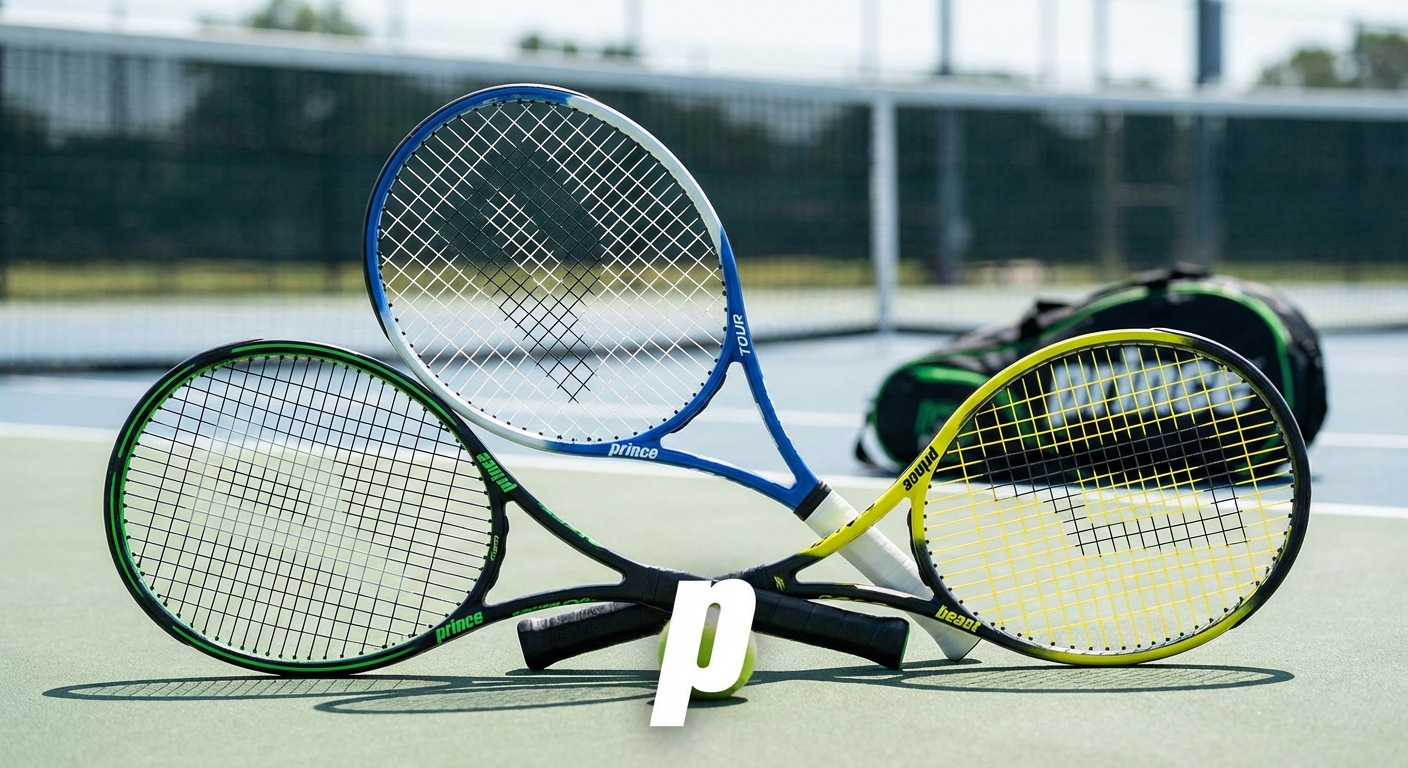
The Prince Racket Lineup: Prince Phantom vs Prince Tour vs Prince Beast
Prince has simplified their catalog into clear families, each serving a distinct type of player. Let's break down the three big ones you need to know about.
Is the Prince Phantom Series Designed for Advanced Purists?
If you miss the thin beams and flexible frames of the 80s, the Phantom is your best friend. This line is arguably the most flexible currently on the market.
Key Specs:
- Beam Width: Ultra-thin (often around 20mm-21mm)
- Flex Rating: Low (very soft, usually mid-50s RA stiffness)
- Target Player: Advanced players with long, fast swings who generate their own power.
Why is the Prince Tour Series Considered the Modern All-Court Workhorse?
The Tour line is the Goldilocks of the Prince family. It sits right in the middle, offering a blend of the Phantom's control and the Beast's power. It competes directly with the likes of the Wilson Blade or Head Speed.
Key Specs:
- Beam Width: Moderate (22mm-23mm)
- Flex Rating: Mid-range (comfortable but stable)
- Target Player: Intermediate to advanced competitors who play an all-court game.
Can the Prince Beast Series Deliver Maximum Power and Spin?
Subtlety is not the goal here. The Beast line is Prince's answer to the "power baseliner" category, going head-to-head with the Babolat Pure Drive.
Key Specs:
- Beam Width: Thick (24mm-26mm)
- Flex Rating: Stiffer (for energy return)
- Target Player: Baseliners looking for easy depth and heavy spin.
Prince Technology Spotlight: How Do O3 Ports and TeXtreme Improve Play?
To understand why Prince rackets play the way they do, you have to look at the tech. These aren't just marketing buzzwords; they are physical differences you can see and touch.
How Do Prince O3 Ports Expand the Racket Sweet Spot?
The O3 system involves large holes (ports) in the frame where the strings enter, rather than traditional small grommet holes.
In a standard racket, the string is locked in place by the grommet. In an O3 frame, the string is suspended across the port. This allows the string to move more freely upon impact.
Why Does String Movement in Prince O3 Rackets Matter?
When strings can move, the sweet spot expands effectively to the edges of the frame. It also increases the "trampoline effect," giving you more power and comfort even on off-center hits. The aerodynamic benefits are also real; the giant holes reduce wind drag, allowing you to swing the racket faster.
Prince TeXtreme x Twaron: Stability Without Added Weight
TeXtreme is a type of carbon fiber fabric that is spread out very thin, rather than being twisted like yarn. Think of it like a flat ribbon versus a round rope.
By integrating this into the racket throat (and often the hoop), Prince can reduce weight while increasing strength. They recently added Twaron (an aramid fiber similar to Kevlar) to this mix. This combination dampens vibration without making the racket feel "dead." It creates a crisp, solid response that tells your hand exactly where the ball went.
What Are the Key Performance Characteristics of Prince Rackets?
When you pick up a Prince, what should you actually expect on the court?
1. Unmatched Comfort: Across the board, Prince is the leader in arm-friendly designs. If you have tennis elbow, the Phantom and Tour lines are often the first recommendations I give. The low stiffness ratings absorb the shock before it travels up your arm.
2. Spin Potential: Especially with the O3 models, the spin generation is massive. Because the strings snap back more freely, you get extra RPMs without changing your swing mechanics.
3. The Muted Response: This is a polarized feature. Some players love the soft, dampened feel. Others find it "mushy." Because of the O3 ports, you don't get that sharp "crack" sound when hitting. It’s a quieter sensation. It can feel like you are disconnected from the ball. This takes getting used to if coming from a crisp frame.
Prince Racket Price Range: Are They the Best Value in Tennis?
Here is where Prince secretly wins the game. The "Big Three" brands often price their flagship rackets between $260 and $300.
Prince generally positions their premium frames (Phantom, Tour, Beast) in the $180 to $230 range. They also frequently offer "legacy" frames—older models that are still being manufactured—for significantly less, sometimes under $140.
For the build quality and technology, Prince offers arguably the best value-for-money ratio in the industry. You aren't paying the "marketing tax" associated with brands heavily endorsed by top ATP/WTA players.
Who Should Buy Prince Phantom, Prince Tour, or Prince Beast Rackets?
Prince is not a one-size-fits-all brand, but they cover specific niches better than anyone else.
1. The Injury-Prone Player: If you feel a twinge in your elbow on a backhand, stop and demo a Prince Phantom or Tour O3. The shock absorption is genuine and can extend your playing career.
2. The "Feel" Player: If you rely on touch, the Phantom's flexible beam provides the dwell time needed to massage the ball.
3. The Value Hunter: If you want a tournament-level frame but refuse to pay $300, Prince provides similar quality for a fraction of the cost.
4. The Spin Doctor: Intermediate players looking to add safety to their heavy forehands will benefit from the O3 system on the Beast or Tour lines.
Are Prince Rackets Suitable for Beginners?
Absolutely. While the Phantom is too demanding, the Prince Beast 100 or the Prince Warrior (an entry-level line) are excellent starting points. They offer a large sweet spot that is forgiving when your footwork isn't perfect.FAQ: Your Top Questions About Prince Rackets Answered
What is the difference between Prince O3 and traditional grommets? expand_more
The main difference is feel and aerodynamics. O3 ports allow strings to move, creating a softer feel and larger sweet spot. Traditional grommets provide a crisper, direct feel. If you want comfort, go O3. For precision, stick to traditional holes (often labeled "ATS" or standard).
Do O3 ports make the racket fragile? expand_more
No. Despite looking like the frame has structural holes, the engineering behind the ports makes the frame incredibly strong. The carbon fiber is reinforced around the ports. I have seen O3 rackets take court abuse without cracking faster than a solid beam racket.
Why does my Prince racket make a "whooshing" sound? expand_more
That is the sound of speed! The large O3 ports allow air to pass through the frame, creating a distinct audible "whoosh" when you swing fast. It’s normal. Some players use it as an audio cue to know they are generating good racket head speed.
Is Prince still a professional-grade brand? expand_more
100%. Just because they don't have the marketing budget of other giants doesn't mean the quality has dropped. Top pros like John Isner and Lucas Pouille have used Prince. The graphite quality and quality control are often rated higher than some of the more popular competitors.
Does the "mushy" feel of Prince rackets reduce power? expand_more
Not necessarily, but it changes the perception of power. Because the vibration is dampened, you don't feel the "pop" as intensely. The ball is still traveling fast, but your hand receives less feedback. This can lead some players to over-swing because they think they aren't hitting it hard enough. Trust the physics, not just the sound.