If you are a parent standing in the sporting goods aisle or scrolling through endless product pages, looking at junior tennis rackets, you might feel a bit overwhelmed. They all look somewhat similar, don't they? You see bright colors, famous brand names like HEAD, and a bunch of numbers like 19, 21, 23, and 25. It’s tempting to just grab the one in your child's favorite color or, worse, buy a larger one thinking they will "grow into it."
Let me stop you right there. As someone who has spent years on the court, I can tell you that equipment sizing for juniors—especially in the 4 to 8-year-old range—is the single most critical factor in whether they enjoy the sport or quit after two lessons. Today, we are looking at two fantastic entry-level options from a giant in the industry: the HEAD Speed Junior Tennis Racquet 21-inch and the HEAD Instinct 23 Junior Tennis Racquet.
Both of these rackets are designed for beginners. Both feature durable aluminum construction. Both carry the HEAD pedigree of quality. But they are distinct tools for distinct stages of a young player's development. The difference between a 21-inch racket and a 23-inch racket might seem negligible to an adult, but for a child, it changes the entire geometry of their swing. In this comparison, I’m going to break down exactly how these two frames differ, how the weight impacts playability, and help you decide which one belongs in your junior player's bag.
Our Top Pick

HEAD
HEAD Speed Junior Tennis Racquet 21-inch
Best Overall:
While the choice depends entirely on the child's height, the Speed 21 gets the win for its incredible ease of use for absolute beginners. It serves as the perfect "first racket," ensuring that the youngest players develop a love for the game without being hindered by equipment that is too heavy or long.
| Feature | HEAD Speed Junior 21 | HEAD Instinct 23 |
|---|---|---|
| Length | 21 inches | 23 inches |
| Weight (Unstrung) | 6.3 oz | 7.6 oz |
| Target Age | 4-6 Years | 6-8 Years |
| Head Size | Mid-Plus (Junior Standard) | Mid-Plus (Junior Standard) |
| Material | Aluminum O-Beam | Aluminum O-Beam |
| Grip Size | 3 5/8 inches | 3 5/8 inches |
| Color | Red | Purple |
| Skill Level | Absolute Beginner | Beginner/Intermediate Junior |
| Balance | Head Light | Head Light |
The Length Factor: HEAD Speed Junior 21 vs HEAD Instinct 23
When we compare the HEAD Speed Junior 21 and the HEAD Instinct 23, the conversation has to start with length. The model names give it away—21 inches versus 23 inches—but let's talk about what that 2-inch difference actually does to a child's game.
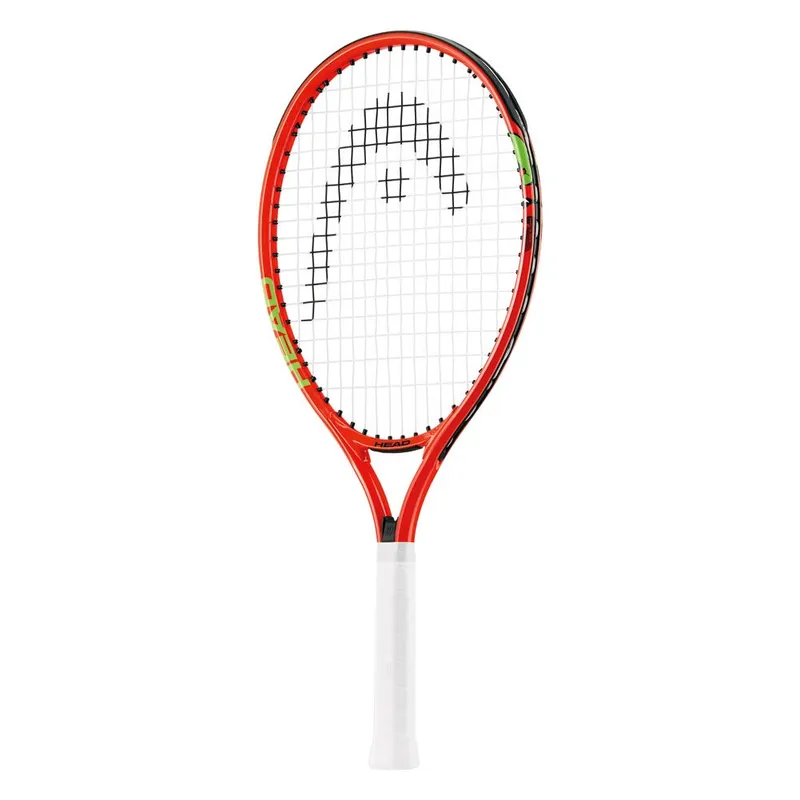
The HEAD Speed Junior 21 is engineered for the 4 to 6-year-old demographic. At this age, motor skills are still developing. A child's ability to judge the distance between their hand, the racket face, and the ball is raw. A 21-inch racket brings the contact point closer to the hand, reducing the lever length and making it much easier to control.
When a 5-year-old swings a 21-inch racket, they are more likely to find the center of the strings because there is less "racket wobble" and less distance to manage. Furthermore, a major issue with young kids is ground clearance. If a racket is too long, they will constantly scrape the court surface on their forehand swing, which ruins the racket and frustrates the kid. The Speed 21 is perfectly sized to allow a natural low-to-high swing path.
The HEAD Instinct 23 is the next logical step. Designed for 6 to 8-year-olds, this racket acknowledges that the child has grown taller and stronger. The extra two inches provide two critical advantages: reach and leverage. As kids move from hitting balls dropped by a coach to actually rallying over a net, they need to cover more court.
The 23-inch length helps them reach balls that are slightly further away. More importantly, the longer lever allows them to generate more head speed. This translates to power. A 7-year-old using a 21-inch racket might feel like they are swinging a ping-pong paddle—they can hit it, but the ball doesn't go anywhere. The Instinct 23 gives them the mechanical advantage needed to push the ball to the baseline.
Weight and Swing Mechanics: 6.3 oz vs 7.6 oz
Weight is the silent killer of junior tennis technique. If a racket is too heavy, a child will drop the racket head, use their wrist inappropriately to compensate, and potentially develop bad habits that take years to fix. Conversely, if it's too light, the racket will twist in their hand upon contact.

At 6.3 ounces, the HEAD Speed Junior 21 is exceptionally light. For a 4 or 5-year-old, this is the sweet spot. It allows them to focus on the motion of the swing—the "C" loop on the forehand or the follow-through over the shoulder—without fighting gravity. I have seen countless young kids struggle with heavier rackets, and they end up just poking at the ball because they can't lift the frame.
The HEAD Instinct 23 comes in at 7.6 ounces. That is a 1.3-ounce difference, which is significant for a junior. This extra weight is necessary for stability. As children get into the 6-8 age range, they are likely hitting slightly heavier balls. A 6.3-ounce racket might flutter or twist when hitting a firmer ball. The 7.6-ounce mass of the Instinct 23 provides a solid "plow through" effect.
Watch: HEAD Instinct 23 Junior Tennis Racquet
This extra mass absorbs the shock of the ball better than the lighter Speed 21, providing a more stable feel at impact. However, this requires the child to have developed some forearm and shoulder strength. The Speed 21 wins for pure maneuverability and injury prevention in very young players, while the Instinct 23 wins for stability and power potential for kids who are physically ready for it.
Build Quality: The Aluminum O-Beam Standard
When we look at the construction of both the HEAD Speed Junior 21 and the HEAD Instinct 23, we see a lot of similarities. Both utilize an Aluminum O-Beam construction. Serious adult rackets are made of graphite, but aluminum is used here for durability and cost.
Let's be honest about junior tennis. Rackets get dropped and scraped against the hard court. Graphite is brittle and cracks upon hard impact with concrete. Aluminum, however, is incredibly resilient. It might dent or scratch, but it rarely cracks structurally under normal junior abuse. Both the Speed 21 and Instinct 23 are built like tanks relative to their weight.
The "O-Beam" refers to the tubular cross-section shape of the frame, which offers good stiffness and stability. In the Speed 21, it helps keep the frame stiff enough to transfer energy to the ball even with a slow swing speed. In the Instinct 23, the design prevents the longer head from feeling "floppy," ensuring a consistent response across the string bed.
Grip Size, Comfort, and Aesthetics
One area where these two rackets are identical is the grip size. Both come with a 3 5/8 inch grip. This is the standard sizing for the 4-8 year age range. It is small enough for little hands to wrap around completely, which is vital for racket control. Both rackets feature a comfortable, cushioned manufacturer grip that is gentle on soft hands.
Regarding aesthetics, the HEAD Speed Junior 21 comes in a vibrant Red, looking fast and sporty. The HEAD Instinct 23 sports a Purple colorway that stands out on the court. While this shouldn't be the primary deciding factor, involving your child in the choice can help them feel more connected to their gear.
HEAD Speed Junior Tennis Racquet 21-inch - Pros & Cons
thumb_up Pros
- check_circle Perfect Weight: At 6.3 oz, it is exceptionally manageable for toddlers.
- check_circle Durability: Aluminum frame withstands heavy abuse.
- check_circle Maneuverability: Short length makes learning fundamentals easy.
- check_circle Grip: Sized perfectly for small hands.
thumb_down Cons
- cancel Short Lifespan: Kids will likely outgrow this within a year.
- cancel Low Power: Relies entirely on the child's swing speed.
- cancel Vibration: Aluminum transmits more shock than graphite.
HEAD Instinct 23 Junior Tennis Racquet - Pros & Cons
thumb_up Pros
- check_circle Stability: 7.6 oz weight handles faster balls well.
- check_circle Reach: 23-inch length helps kids cover more of the court.
- check_circle Value: Exceptional price for a branded, durable racket.
- check_circle Ready to Play: Comes pre-strung with durable synthetic gut.
thumb_down Cons
- cancel Weight Jump: Can be tiring for smaller 6-year-olds.
- cancel Limited Customization: Weight and balance are fixed.
- cancel Color: Purple is the only option available.
Final Verdict: Which One Fits Your Junior Star?
Choosing between these two is not about choosing the "better" racket; it is about choosing the correct size. Using the wrong size racket is the quickest way to hinder a child's development.
Choose the HEAD Speed Junior 21 if your child is between 4 and 6 years old, roughly 40 to 44 inches tall, and is just starting out. Choose the HEAD Instinct 23 if they are between 6 and 8 years old, roughly 45 to 49 inches tall, and have the strength to handle a slightly heavier frame.
How do I know if the racket is too big for my child? expand_more
Have your child hold the racket by the grip and let it hang naturally at their side. If the tip of the racket touches the ground, it is too long. The racket should hover about an inch off the ground. If they have to bend their elbow to keep it off the floor, size down to the
Do these rackets come with a cover? expand_more
Usually, these specific entry-level aluminum models do not come with a full cover. The focus is on keeping the price low for the racket itself.
Can I restring these rackets? expand_more
Yes, but it is rarely cost-effective. The cost of stringing often equals the price of the racket. Most parents upgrade to the next size rather than restring.
Is the aluminum frame bad for my child's arm? expand_more
No. For children using low-compression balls, the impact shock is minimal. The risk of injury comes more from using a racket that is too heavy, not the material itself.