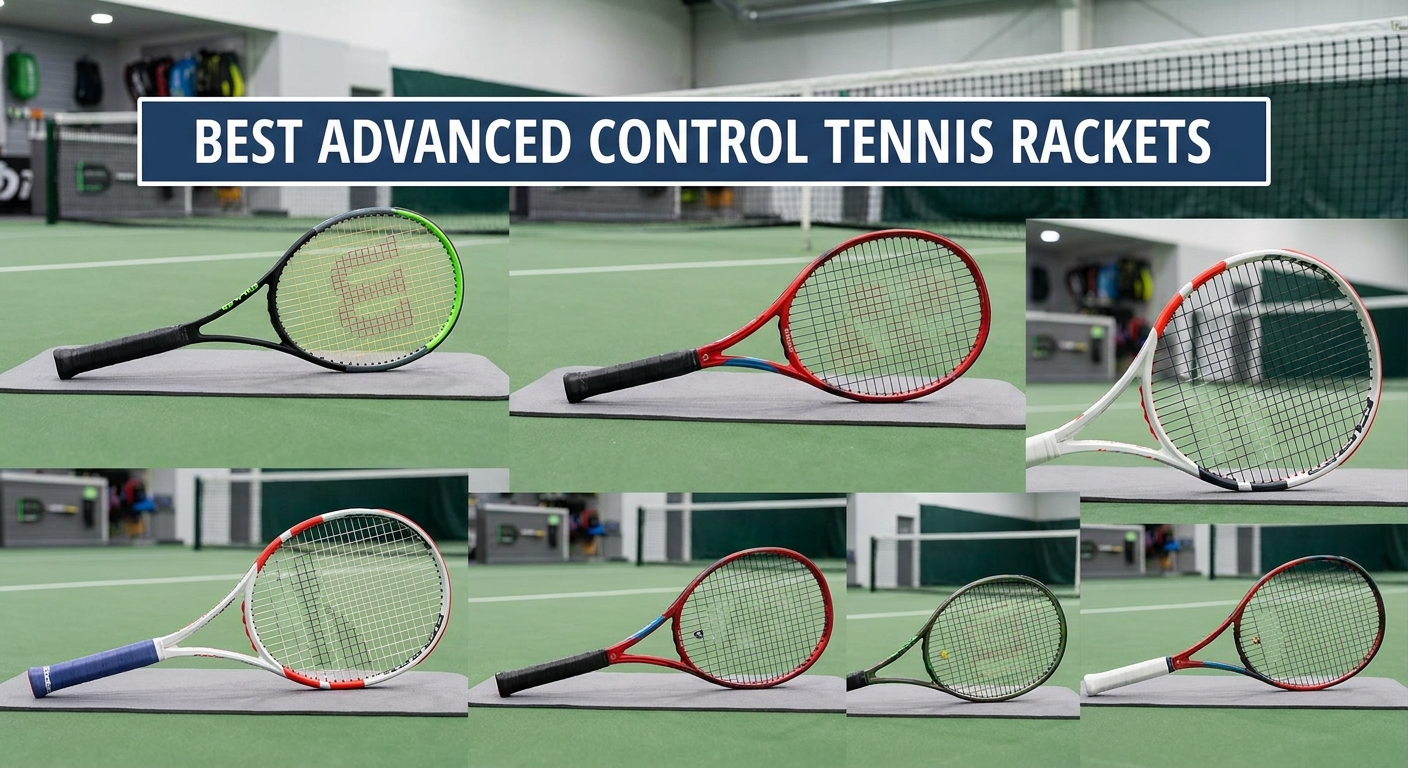
Why Choose the Wilson Blade 98 V9, Yonex Vcore 95, or Babolat Pure Strike 97 for Advanced Control?
When you reach a certain level on the court, your equipment needs to stop helping you generate pace and start helping you tame it. If you are consistently swinging fast, finding your targets, and feeling like your current racket is launching balls into the back fence whenever you step on the gas, you have officially graduated to the advanced control category. We are talking about precision instruments built for players who bring their own power to the court.
In this tier, we prioritize control-oriented frames like the Wilson Blade or Yonex Vcore that offer exceptional predictability. We evaluate these rackets based on how their swing weight feels dynamically through the air, how their flex rating impacts your tendons during a grinding three-hour match, and how consistently their string bed reacts under heavy impact. Finding the right match is like picking a dance partner—it requires a deep understanding of your own mechanics and preferences.
Before diving in, it is crucial to remember that we tested all these frames with an identical polyester string setup tensioned at 52 pounds. Evaluating rackets with wildly different strings is an exercise in futility, so keeping the engine consistent lets the true nature of the frame shine through.
How Do the Wilson Blade 98 V9, YONEX Vcore 95, Babolat Pure Strike 97, and Tecnifibre TF40 305 Compare?
How Does the Wilson Blade 98 (16x19) V9 Handle High-Pace Rallies?
Stepping onto the court with the
The true magic of this frame lies in its versatility. It does not excel at just one thing; rather, it scores an A-minus in almost every category. The power potential is relatively low, demanding full, confident strokes, but the resulting depth is incredibly consistent. Up at the net, it moves quickly and absorbs heavy passes beautifully, making it an ideal choice for an all-court player who likes to transition forward.
In my real-world testing, I found the 16x19 string pattern offered just enough bite to yank my opponent off the court on sharp angles. The frame feels solid on contact, muting harsh vibrations while still giving you the exact feedback needed to know where you struck the ball on the string bed. It is an arm-friendly option for players who still want to feel connected to their shots.
Ultimately, this is a racket that demands respect but rewards good mechanics generously. It will not bail you out if you are out of position, but if your footwork is sound, it delivers the ball on a silver platter.
Is the YONEX Vcore 95 the Best Surgical Tool for Advanced Precision?
There is something inherently intimidating about a 95-square-inch head size in today's era of massive, oversized frying pans. However, the
Taking full swings from the baseline with this racket feels like slicing through butter. The aerodynamic throat design reduces drag, allowing you to generate exceptional racket head speed. This speed translates into a surprising amount of spin, bringing the ball down sharply just inside the baseline. It is a control-oriented dream that still allows you to play a heavy, modern game.
When you flatten out a drive, the plow-through is sensational. Because the mass is concentrated precisely where it needs to be, you do not get pushed around by heavy incoming pace. Volleying requires focus—if you hit outside the center, the frame lets you know—but catch it clean, and the ball simply dies on the strings for perfect drop volleys.
If your footwork is reliable and you love dictating play with precision rather than brute force, this scarlet beauty is an incredibly rewarding piece of engineering.
Is a 95-square-inch head size too demanding for intermediate players? expand_more
Generally, yes. Smaller frames demand precise footwork and consistent center-ball striking. Intermediates are usually better served by 98 or 100 square inch frames that offer a larger margin for error.
Does the isometric head shape really make a difference? expand_more
Absolutely. By optimizing the intersection of the main and cross strings, it creates a larger sweet spot, particularly in the upper half of the string bed where modern players tend to make contact.
Why Choose the Babolat Pure Strike 97 4th Gen for Aggressive Attacking?
Babolat is famous for raw power, but the
The first thing you will notice is the crisp, immediate feedback upon contact. Unlike plusher frames that pocket the ball for a long dwell time, the Pure Strike gets the ball in and out of the string bed quickly. This translates to an incredibly connected feel, letting you redirect pace effortlessly down the line. It is unapologetically aggressive.
We need to talk about the balance point, which refers to how the weight is distributed from handle to tip. This frame leans toward being head-light, which means the mass sits closer to your hands. Because of this, the racket feels exceptionally maneuverable, allowing you to whip the head through the zone on the run or react instantly during rapid-fire net exchanges.
While it offers slightly more free power than others in this category, it never feels wild. The tighter string spacing in the center of the frame ensures that when you go for a tight window, your ball stays exactly on its intended trajectory.
This is the perfect racket for an attacker who wants a scalpel but still likes the crisp, modern feel of a stiffer layup.
Does the Tecnifibre TF40 305 16M Provide the Most Plush Stability?
The
From the baseline, the TF40 acts like a brick wall against heavy pace. You can effortlessly block back massive first serves or drive through heavily spun defensive balls without the frame twisting in your hands. It provides a unique sensation of trapping the ball on the strings before launching it with surgical accuracy.
The 16M version we tested features a 16x19 string pattern, providing a generous window for spin while maintaining the inherent control of a dense frame. The sweet spot is wonderfully predictable, and the slightly beefier swing weight means the racket does a lot of the heavy lifting for you once you get it moving.
It is a racket that heavily rewards smooth, continuous mechanics. If you have a fluid stroke, the frame naturally plows through the ball, generating a heavy, penetrating shot that pushes opponents deep into the corners.
What exactly does string pattern density affect? expand_more
String pattern density dictates how much the strings move and grip the ball. An open pattern (like 16x19) gives you higher power potential and easier spin because the strings snap back, while a dense pattern (18x20) offers maximum control and extended string life.
How does a head-light vs head-heavy balance change my game? expand_more
Head-light frames put the weight near the handle, making the racket easy to swing quickly and maneuver at the net. Head-heavy frames put the weight at the tip, adding stability and power from the baseline but feeling sluggish up close.
Wilson Blade 98 vs YONEX Vcore 95 vs Babolat Pure Strike 97 vs Tecnifibre TF40 305 Comparison
To truly understand how these titans stack up, we need to look at them side-by-side. While they all occupy the advanced control space, their individual characters are defined by slight mathematical differences.
| Feature | ||||
|---|---|---|---|---|
| Head Size | 98 sq in | 95 sq in | 97 sq in | 98 sq in |
| String Pattern | 16x19 | 16x20 | 16x20 | 16x19 |
| Beam Thickness | 21mm | 21.5mm | 21-22mm | 21.7mm |
| Playability Focus | All-court Feel | Aerodynamic Precision | Crisp Aggression | Plush Stability |
Notice how tightly grouped the beam thicknesses are. Anything hovering around 21mm is firmly entrenched in the control category. Thinner beams flex more, preventing the ball from flying long, whereas thicker, stiffer beams act like a trampoline to generate pace.
How to Select the Wilson Blade 98 V9 or Babolat Pure Strike 97 Based on Technical Specs?
When shopping for an advanced control racket, the specs are your roadmap. You cannot simply grab a frame off the wall and hope it suits your mechanics. First, pay attention to swing weight—the dynamic measurement of how heavy a racket feels when it is in motion. A higher swing weight gives you incredible plow-through against big hitters, but it requires much more physical effort to accelerate through the strike zone over a long match.
Next, consider the flex rating (RA). This number measures how stiff the frame is. A lower RA (usually in the low 60s) means the racket bends more upon impact. This absorbs shock, creating an arm-friendly experience that protects your elbow and wrist. Higher RAs transmit more energy back into the ball for a crisper, more powerful shot, but they can be jarring if you mistit.
Beam width is another critical factor. Advanced frames feature thin beams (typically 20mm to 22mm), which reduces free power but dramatically increases control.
Lastly, never overlook your grip circumference. A grip that is too large prevents optimal wrist snap, while one that is too small forces you to squeeze too hard, often leading directly to tennis elbow. Always measure properly or err on the side of slightly smaller, as you can build it up with an overgrip.
Your racket is an extension of your arm. The right combination of swing weight, flex rating, and string setup will make you feel invincible, while the wrong mix will feel like swinging a two-by-four.
Can the Dunlop SX300 Tour or Dunlop FX500 Tour Serve as Quality Budget Alternatives?
Premium advanced control frames command premium prices, generally sitting in the $230 to $280 range. If you are deeply invested in your tournament game, this is a worthy investment. However, do not be afraid to look at previous generation models. Racket technology moves incrementally, not drastically.
You might also consider alternatives in slightly different weight classes within the same line. Sometimes, dropping 10 grams of static weight can save you a bit of money and provide a more manageable entry point into the advanced control category. Frames like the
Final Verdict: Is the Wilson Blade 98 V9, YONEX Vcore 95, or Babolat Pure Strike 97 the Ultimate Choice?
Choosing a winner in this elite category is challenging because playability is highly subjective at this level. What feels like a magic wand to a flat-hitter might feel terribly underpowered to a spin-junkie.
If you want absolute precision, lean into the Yonex. If you attack early and often, the Babolat is your weapon. But if you need a racket that handles every situation on the court with grace and predictability, the Blade stands alone.
How do I know if I'm physically ready for an advanced control racket? expand_more
If you can consistently generate your own power, hit your targets smoothly, and feel like your current \"tweener\" racket is flying long when you take a full, aggressive swing, you have outgrown it and should test a control-oriented frame.
What are the best strings to use in these specific frames? expand_more
Advanced players typically use polyester strings for maximum spin and control. However, because these frames are already low-powered, stringing them in the low 50s (or even upper 40s) or utilizing a hybrid setup with a multifilament can help optimize the sweet spot.